Daniel Russell and Tabitha Russell’s marriage
The HumansDaniel Russell and Tabitha Russell’s marriage is shown most fully not through a history of the couple’s life together but through the ordinary care that surrounds Daniel’s heart condition and the sudden emergency that ends in his death. Tabitha’s attentiveness, their plans for a trip to Egypt, and her grief make their dependence on one another legible to the Alien narrator, who recognizes in their intimacy something he had expected to scorn.
A Shared Domestic Life
At the Russells’ home, the marriage first appears through the small negotiations of domestic life. Tabitha offers the Alien narrator coffee, fruit juice, or water, mentioning that she and Daniel have acquired a taste for pomegranate juice. Daniel, she says, regards claims about antioxidants as a marketing ploy. The difference is slight, even lightly comic: she describes a shared preference while also conveying his skeptical outlook. Their household accommodates both her choices and his opinions without making either a dramatic point of conflict.
The kitchen is cluttered, with saucepans hanging overhead, and an envelope is addressed to Daniel and Tabitha Russell. These details place the pair together within a shared home and a shared daily world. The narrator’s attention to the address and to the couple’s domestic habits registers a relationship through its surroundings: their life together is present in the objects and routines he is still learning how to interpret.
Illness and Care
Daniel’s heart attack is not the first. Tabitha reminds the Alien narrator that Daniel has had one before, treating his apparent ignorance as evidence that he is not the only overworked mathematician in the world. Her response locates his condition within an ongoing reality for the couple rather than an isolated scare. She says he is taking beta-blockers and that she is trying to persuade him to eat muesli and skimmed milk and take things more easily.
That account gives care a practical, continuing form. Tabitha is not merely reacting to illness after it arrives; she is trying to change Daniel’s food and pace of life in response to it. Daniel’s skepticism about antioxidants and her efforts to adjust his diet suggest different attitudes toward health, but the passage presents these as parts of their shared routine, not as evidence of estrangement. Her concern has to coexist with his habits and judgments.
The Emergency and Their Shared Future
When Daniel collapses, the Alien narrator steps out onto the landing and calls for Tabitha to summon an ambulance. She arrives upstairs in panic, kneels beside her husband, and tries to put an aspirin in his mouth, but his mouth will not open. While speaking to the emergency operator, she identifies their location and insists that Daniel is dying. The speed of her response and the physical closeness of her attempt to help expose how suddenly the couple’s familiar arrangements have become a crisis.
Daniel tries to warn Tabitha, but can only make an indistinct sound. She strokes his hair and urges him to think of Egypt: their trip is two weeks away, and she reminds him that he has always wanted to see the Pyramids. The plan gives her words a concrete point of hope. Egypt is not an abstract comfort but a future they have already arranged and expected to share; as Daniel’s condition worsens, Tabitha tries to hold that future in place by describing it to him.
Love, Loss, and the Narrator’s Recognition
The emergency changes the Alien narrator’s understanding of the marriage. Watching Tabitha crouched over Daniel, he feels an unfamiliar longing, although he cannot identify what he longs for. He recognizes that he has prevented blood from reaching Daniel’s heart, making the scene not only an encounter with the couple’s distress but also one in which his own intervention has caused it. His whispered refusal does not reach Tabitha, whose attention remains on her husband.
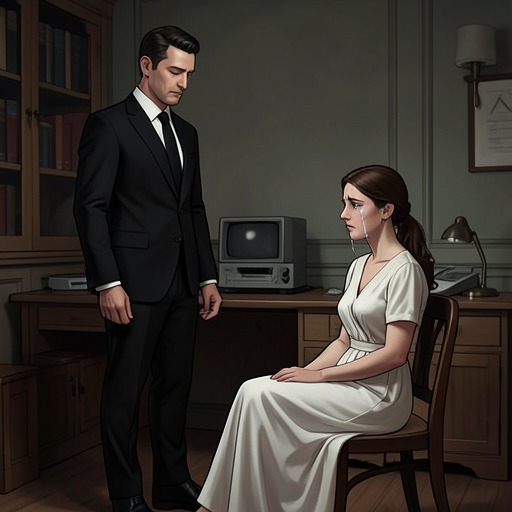
Tabitha tells Daniel that she loves him and begs him to stay with her because she cannot live alone. With Daniel’s head on her knee, she continues to caress his face. The narrator interprets what he sees as two life forms in mutual reliance. He had expected to regard such dependence as weakness, something to scorn; instead, the scene unsettles that judgment. The marriage becomes the evidence through which an alien observer first understands that attachment can be more than vulnerability or need.
Daniel stops making noise, and his body seems heavier against Tabitha. The creases around his eyes relax; he is dead. Tabitha’s howl follows, a sound the narrator has never heard and finds deeply troubling. The ending makes the marriage’s mutual reliance painfully asymmetric: Daniel is gone, while Tabitha remains to experience the separation. Her grief, rather than any account of the couple’s earlier history, gives their bond its decisive force in the narrative.